
|
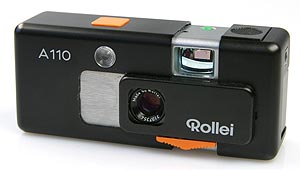
| A 110 "Made in Germany" |
| mit Tessar 1:2,8/23mm | ||
| Rollei Prontor Zentralverschluss 1/400sec bis 4sec |
||
 |
||
| 13x17mm | ||
| Baujahr Kamera | ||
| Produktionszeit Kamera | 1974-78 | |
| Kamerapreis 1975 | DM 548,- | |
| Kadlubek-Nummer | ROL0610 | |
| Prochnow-Nummer | PR 530/2 | |
| Produktions-St�ckzahlen | 124000 |
Rolleis
Erfahrungen auf dem Gebiet besonders kleiner Kameras, wie beispielsweise
der
Rollei 16 S, haben gezeigt, dass sich Kleinstbildkameras nur dann auf dem Markt
durchsetzen
k�nnen, wenn weltweit
geeignetes Filmmaterial zur Verf�gung steht. Dies war nun mit dem
Kassettenfilm
110 der Fall. Die Erkenntnisse bei der Konstruktion der Rollei A 26 und die
logische
�bertragung des Zug-Schiebe-Prinzipes auf eine Kleinstbildkamera f�r
den 110er-Film haben zu einer
Kamera gef�hrt, die bei h�chster Pr�zision und
hervorragendem Bedienungskomfort kaum l�nger und
tiefer ist als die verwendete
Filmkassette und zudem noch sechs Millimeter kleiner als die Filmverpackung.
Die
von anderen Herstellern angebotenen Pocket-Kameras lagen in der unteren und
mittleren Preislage
und waren wesentlich gr��er als die Filmkassette. Die
Rollei A110 war die wohl kleinste, teuerste und
sch�nste ihrer Gattung. Mit
ihrer optischen Ausstattung, dem Carl Zeiss Tessar mit Lichtst�rke 1:2,8,
lag
sie ebenfalls an der Spitze. Auch die anderen Merkmale der Kamera stellten
Spitzentechnik dar.
Erstmalig
wurde bei einer Pocket-Kamera eine automatische richtige Belichtung bei Blitzw�rfel-Aufnahmen
verwirklicht. Rollei bezeichnete die Funktion als �CC�
Die schnelle Silicium-Fotodiode mi�t nicht nur das Tageslicht,
sondern auch den Blitz, und schlie�t den
Kameraverschlu� nach korrekter
Belichtung. So regelt die Kameraelektronik ebenfalls
Tageslichtaufnahmen mit
Aufhellblitz. Aus der A 110 sollten zwei weitere Modelle abgeleitet werden,
um
sie in einer niedrigeren Preisklasse anbieten zu k�nnen. Die Entwicklung der
ersten Variante mit
dem Namen E 110
w�hrend die
zweite M 110 verworfen wurde.
Rolleis experiences having turned out in the field of particularly little camerae, such as the Rollei 16 S,
that miniature cameras only then can gain acceptance on the market if worldwide suitable film is available.
This was the fall with the cassette film 110 now. The traction the cognitions for the construction of the Rollei
ares 26 and the logical transfer blame Prinzipes on a miniature camera for the 110s film have led to a camera,
which is hardly longer and deeper than the used film cassette at the highest precision and excellent operator
convenience and moreover still six millimeters more smally as the film packing. The Pocket camerae offered
'
by other manufacturers lay in the lower and middle price range and were fundamentally bigger than the film cassette.
The Rollei A110 was the probably small, expensive and beautiful its genre.
With its optical equipment, the Carl Zeiss Tessar with light intensity 1:2,8, it also lay at the lead.
The other features of the camera also represented top technology.An automatic right exposure was made
come true at flashcube photos at a Pocket camera for the first time.
Described Rollei the function when Cube computer (flash) lightning automatic system.
The fast silicon photodiode measures not only the daylight but also the
lightning and closes the camera shutter after a correct exposure.
So camera electronics also regulates daylight photos with on-lager lightning.
Another two models should be derived to be able to offer them in a lower price range end of the ares 110.
The development of the first variant with the name E 110 was completed in July 1975 and went in production
in July 1976, lasting this one second m 110 depravedly was.
