
|
| Prominent 1 Type 128 |
| Verschluss | 1/500 - 1sec + B | 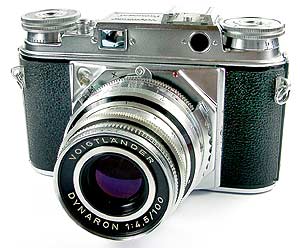 |
| 24x36mm | ||
| Baujahr Kamera | 1956 | |
| Produktionszeit Kamera | 1956-58 | |
| Kamerapreis 1956 | DM 250,- | |
| Kadlubek-Nummer | VOL1091 | |
| Produktions-St�ckzahlen | ca. 11000 |
Bei der Voigtl�nder Prominent wurde erstmalig in einer Kleinbildkamera das
Prinzip
Zentralverschlu� und auswechselbare Optik zur Anwendung gebracht.
Die Prominent'
Type 128 hatte erstmals einen Schnellaufzugknopf, eingespiegelte Suchermasken
f�r
35 + 50 + 100mm sowie einen Leuchtrahmensucher.
Es l��t sich nichts gegen den
bew�hrten Schlitzverschlu� sagen, der vor
allem bei Sportaufnahmen unentbehrlich ist.
In den F�llen jedoch, wo
beispielsweise der Bildreporter bei Tageslichtaufnahmen ein
Blitzger�t zur
Aufhellung der Schatten einsetzt, f�hrt der Schlitzverschlu� zur �berbelichtung
oder doppelten
Konturen schnellbewegter Objekte, weil eine zuverl�ssige Synchronisation
in den 50iger Jahren nur bei einer 1/30 sec. m�glich war. Durch den bei der
Voigtl�nder Prominent eingesetzten Synchro-Compur Verschlu� sind Verschlu�zeiten
mit bis zu 1/500 sec.
m�glich. Diese Technik war f�r viele fotografisches
Neuland, das zu erforschen eine
lohnende Aufgabe war.
With the Voigtl�nder Prominent for the first time the principle did not become centralshutter
and replaceable optics the application of
brought. Prominent the type 128 had for the first time a high-speed elevator button, Suchermasken for 35 + 50 + 100mm and a
Cristallglasfinder.
It can to anything against the proven slot catch be said in a 35mm camera, which is indispensable
with sport photographs particularly. In the cases however, where for example the
reporter uses
a flash appartus with daylight photographs for the clarification of the shade, the slot catch leads
to the
overexposure or doubled outlines of fast-moved objects, because a reliable
synchronisation was possible into the 50iger years only at a 1/30 second. By with the
Voigtl�nder Prominent used Synchro Compur catch are Shutter-Times with up to 1/500 second possible. This technology was
for many photographic new ground, which was to investigate a worthwhile task.
