|
| JSOLETTE Apotar/Co-R |
| mit Agfa Apotar 1:4,5/8,5cm |
||
| 6x6cm | 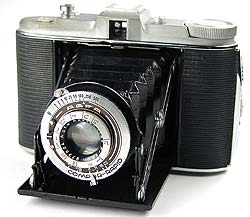 |
|
| Baujahr Kamera | 1949 | |
| Produktionszeit Kamera | 1946-49 | |
| Kamerapreis 1949 | DM 98,- | |
| Kadlubek-Nummer | AGF1663 | |
| Produktions-St�ckzahlen |
Klar, elegant und sauber ist das mit kratzfestem Robusit �berzogene
Geh�use und die Kopfplatte. Auf ihr ist neben dem Aufsteckschuh, dem
Filmtransportknopf und dem eingebaute hellen Fernrohrsucher auch der
Geh�useausl�ser angebracht. Der Compur-Rapid-Verschlu� besitzt
einen Zeitenbereich von 1 - 1/500sec. + B. Als Objektiv kam das beliebte
Agfa Apotar mit einer Lichtst�rke von 1:4,5 zum Einsatz. Die Kamera ist
mit der silberfarbenen Deckkappe leicht von dem schwarzen Vorkriegsmodell
zu unterscheiden. Die schwarze Vorkriegs-Isolette auch als Ur-Isolette
bekannt
wurde bereits im "Agfa Amateur Katalog 1938" als die
Soldatenkamera
mit dem treffsicheren Zielsucher bezeichnet. Heute bezeichnet man in
Sammlerkreisen
die schwarze immer noch als die Soldaten-Isolette.
The housing covered with scratch-proof Robusit and the head end plate are clear, elegantly and cleanly. On its also the housing trip is attached bright Fernrohrsucher inserted beside the accessory shoe, the film transportation button and that. The Compur rapidly catch possesses a time range of 1 - 1/500sec. + B. as objective was used the popular Agfa Apotar with a luminous intensity of 1:4,5. The camera is to be differentiated with the silberfarbenen cover cap easily from the black Vorkriegsmodell to. The black Vorkriegs Isolette also as Ur-Isolette admits in the "Agfa amateur catalog 1938" as the soldier camera with the accurate homing head was already designated. Today one calls the black in collecting tank circles still the soldier Isolette.
